Transparency
We'd rather show you than ask you to trust us.
Most AI companies ask you to take their privacy and safety claims on faith. rAIdio.bot is architected so you don't have to. Here is exactly what the product does, where the data goes, and what we can prove.
100% local, 0% cloud
rAIdio.bot is a desktop application. It runs on your GPU. It does not call home, phone out, send telemetry, upload your prompts, or upload your audio.
We do not run a backend. There is no account system. There is no cloud infrastructure behind rAIdio.bot because none is needed.
This is a structural design choice, not a policy promise. A company can change its privacy policy. rAIdio.bot has no infrastructure to change its mind about.
Concretely, the application’s entire network behaviour in normal operation comes down to four things: local loopback to its own ComfyUI subprocess on your machine; first-run downloads of open AI models from our own Hugging Face model mirror; a one-time download of a static ffmpeg build from a public release mirror; and a startup check for a newer version. That is the entire list. No telemetry destination, no analytics endpoint.
The update check reads, it does not report. On startup rAIdio.bot asks our GitHub releases and our download CDN whether a newer version of the application exists. It sends no telemetry, no identifiers, no usage data, and nothing about you or what you make. It reads a version number and tells you if there is a newer one. It is not required: block it, or stay offline, and the application still works.
C2PA signed provenance
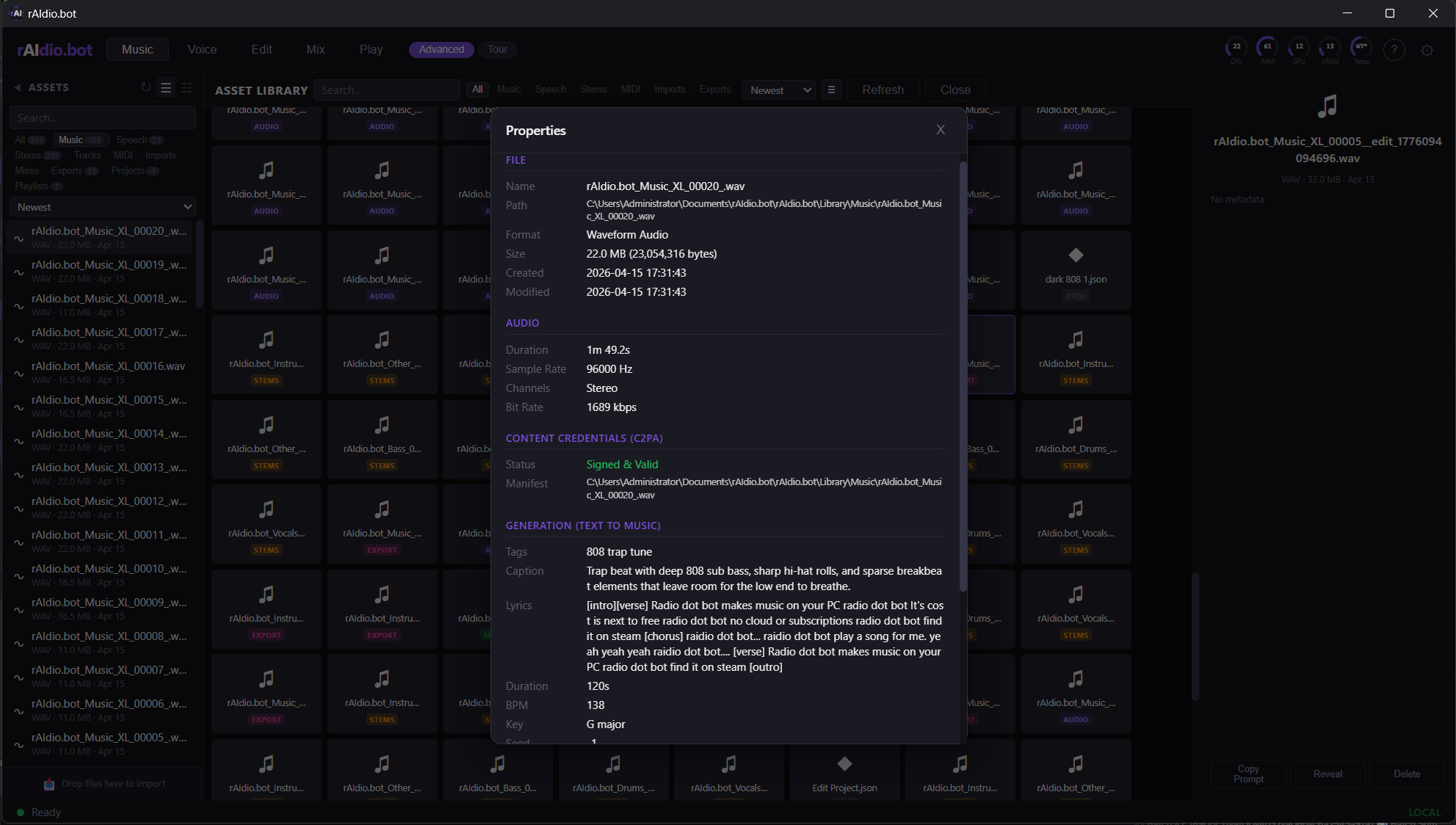
Every file rAIdio.bot generates can carry a C2PA content credential, a cryptographically signed, tamper-evident record of:
- That the file was made with rAIdio.bot
- Which AI model generated it
- When it was made
- Who made it (you, if you tell it who you are)
- What tools and transformations were applied
C2PA is the open provenance standard adopted by Adobe, Microsoft, the BBC, Sony, and major camera manufacturers. Your signed credentials travel with your files. They're proof of authorship you can defend, to platforms, to collaborators, to courts.
Signing is on by default. You can turn it off in Settings. We strongly recommend keeping it on.
Neural in-signal watermark
A C2PA credential lives in the file's metadata. That's the right place for a cryptographic signature, but metadata can be stripped: re-upload a track to a social platform, screen-record it, or re-encode it, and the credential can fall away.
So rAIdio.bot adds a second, complementary layer. Every track it generates carries an inaudible neural watermark woven directly into the audio signal itself, not the file wrapper around it. The mark rides inside the sound, so the signal that says “this audio was AI-generated by rAIdio.bot” is designed to survive the trip through re-uploads, format conversion, and compression.
The watermark marks the content, not the person. It is a machine-readable AI-origin signal for platforms, detectors, and downstream tools, so software can recognise the audio as AI-generated. It does not encode who you are and it does not track what you make.
- Imperceptible. Listeners hear the music, not the mark.
- Strip-resistant. Verified to persist through sample-rate conversion (44.1 ↔ 48 kHz), MP3, and FLAC. Robust to normal handling, not a guarantee against a determined adversary.
- Built on SilentCipher, Sony's open-source (MIT) neural audio watermarking. Not a homegrown black box.
- Only on AI output. rAIdio.bot marks the tracks it generates, never recordings you import. Marking a real performance as AI-made would be a lie, so it doesn't.
Two layers, two jobs. C2PA is the cryptographic, tamper-evident record of how a file was made. The neural watermark is the survivor that keeps the AI-origin signal machine-readable after the file has been through the internet. Both are visible in a track's Properties. Together they are built for the kind of robust, multi-layer marking the EU AI Act's transparency expectations point toward.
Open Software Bill of Materials (SBOM)
rAIdio.bot is built on top of 998 open-source components. We publish a complete CycloneDX-formatted Software Bill of Materials that lists every one, with its version, license, and source. Every time we release an update, the SBOM is regenerated and republished.
- rAIdio-bot/sbom on GitHub, the full CycloneDX SBOM, updated with every release
- Human-readable Third-Party Notices, every component, its license, and its source
The mix is overwhelmingly permissive open-source licenses (MIT, Apache-2.0, BSD, MPL). A small number of copyleft dependencies (GPL, LGPL) are included, all either used as dynamically linked libraries or run as isolated processes, in accordance with their license terms. Every component has a declared license. Zero unlicensed dependencies.
EU AI Act transparency statement
rAIdio.bot publishes a full transparency statement compliant with the EU AI Act (Regulation EU 2024/1689). It documents every AI system in the product, the training data provenance, the risk classification, our synthetic media safeguards, and our ongoing compliance commitments.
Read the EU AI Act Statement →
Voice consent architecture
Voice cloning is powerful and dangerous. We built the consent check into the workflow, not around it.
Before rAIdio.bot clones a voice, you must:
- Name the voice owner (or state “myself”)
- Describe the intended use
- Attest that you have permission
This consent record is embedded in the C2PA provenance of every file. It doesn't stop bad actors from lying, but it creates a verifiable audit trail that establishes what was claimed, when, and by whom. If a voice clone ever shows up where it shouldn't, the provenance tells part of the story.
No training data harvesting
rAIdio.bot does not send your inputs, outputs, prompts, recordings, or usage data anywhere. We cannot train on what we do not receive. The AI models included in rAIdio.bot were trained by their respective authors (all documented in the EU AI Act statement and the Third-Party Notices), rAIdio.bot ships those models as-is and runs them on your hardware.
Open source where it matters
Core components of rAIdio.bot are open source and mirrored on our GitHub organization:
- rAIdio-nodes, custom ComfyUI nodes, chord detection, ACE-Step XL support
- User Manual, full documentation
- System Check, pre-purchase compatibility tool
- SBOM, published software bill of materials
The Rust application binary is proprietary. The AI models and the Python/ComfyUI backend are open source and run as isolated processes.